
 Burnley
 Blackburn Rovers
 Coventry City
 Derby County
 Leeds United
 Luton Town
 Middlesbrough
 Millwall
 Norwich City
 Portsmouth
 Sheffield Wednesday
 Sheffield United
 QPR
QPR


St Andrew’s, or ‘St Andrews @ Knighthead Park’ to give it its full name for sponsorship purposes, has been the soul of Birmingham City since 1906, but Tom Wagner wants to move to a more modern, more lucrative home.
After watching the club he acquired in 2023 triumph in League One in 2024-25, Wagner is dreaming big.
During his speech on the pitch on the final day of the campaign at St Andrews, he said: “I promise you this is not the best day that we will enjoy together.”
But, in the modern football finance ecosystem with Profit and Sustainability Rules (PSR) and an arms race in the transfer market, your dreams are only as big as your bottom line.
Wagner wants promotion to the Premier League in 2025-26 – but to realise his ambitions, he knows that he needs to continue to scale Birmingham City as a business.
That is why Tom Brady is in the West Midlands, to provide the buzz that the owners rightly predicted would translate to commercial income.
But it’s going to take more than clever marketing. Increasingly, clubs are realising the power of their fanbase and their biggest asset of all: the stadium.
Around half a dozen Premier League clubs are either planning expansions, currently undergoing them, or have recently completed capacity increases.
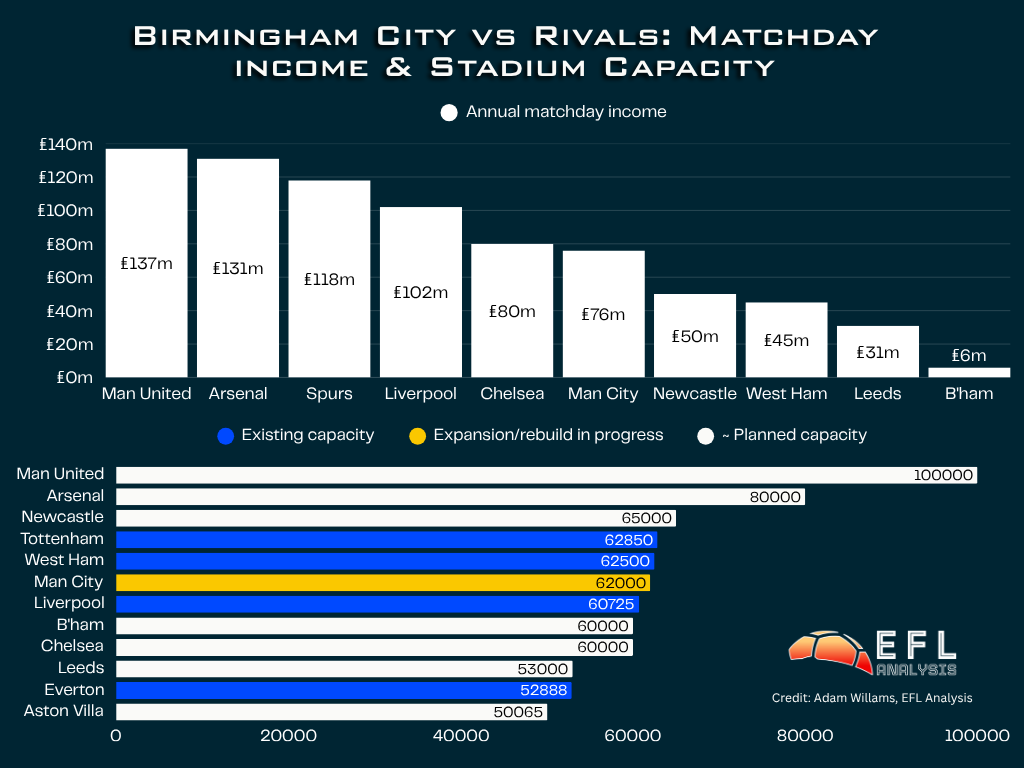
Make no mistake, TV money is still king. However, media revenue is volatile from season to season depending on European qualification and the remarkable growth in the value of TV rights we have witnessed in the last decade has started to plateau too.
And though commercial income is rising across the board, it’s an uber-competitive market and clubs struggle to get an edge over their rivals in that field. But matchday income? There are only so many clubs who can bring in massive crowds, so this is where many owners think the real strategic advantage lies.
Birmingham, whose catchment area is a city of over a million people, are perhaps uniquely well positioned to take advantage. Today, the Blues took a “huge step forwards” in their plans to build a ‘Sports Quarter’ for the city, with a 60,000-seater stadium as its beating heart.
Chancellor Rachel Reeves has committed £2.4bn to fund transport infrastructure in the West Midlands Combined Authority, with a significant chunk of the money going towards extending the Metro to the proposed site of the Sports Quarter.
But beyond the rendered images, which the club has said are for illustrative purposes only, what might St Andrews 2.0 look like?
Tom Wagner will look to exploit hospitality sector to fund new stadium, just like Allianz Arena – Kieran Maguire
When it comes to stadium capacity, less is sometimes more.
In the NFL, there is a trend of teams actually downsizing their stadiums in order to accommodate more hospitality seats whose occupants pay far more on a per-match basis than the average fan.
The NFL was also the first major sports league to pioneer the concept of the ‘sports city’, which is clearly what Wagner wants to inspire in Birmingham. In these hubs, the stadium itself brings in the punters, but it might be the commercial and residential units that make the real money. It’s a flywheel approach.

But will the Blues, whose average attendance of 26,190 last season was a few thousand shy of St Andrew’s full capacity, be able to fill a stadium the size of Tottenham, Liverpool or Manchester City’s?
“Birmingham is the second biggest city in England,” observes University of Liverpool football finance lecturer and Price of Football podcast host Kieran Maguire, speaking exclusively to EFL Analysis.
“Unlike Manchester or Liverpool, it has traditionally had one-and-a-half teams in the top flight. Birmingham have always been the junior club, though they will point to the fact they too have had success.
“So it will take time to build up a fanbase. Yes, I think there will be a lot of interest, but unless they are in the Premier League, a 60,000-seater stadium is going to look unrealistic. If we look at the attendances in the Championship – which are very, very good by European standards – you see it will take time to develop a fanbase like that.
“There is an argument for saying ‘build it and they will come’. In the majority of cases, that has proven to be the case, even when the fans have been sceptical. So it can be done, but you have to market it very well.
“Today, Wagner’s company – or Shelby Industries, as it’s officially known – has tapped into the psyche of the city. There are the Tom Brady links as well. All of that is great.

“In the Premier League, clubs only make £1 in £7 from ticket sales, so you have to get the pricing right. Then, you have that position of clubs who get to the edge of the Big Six and then the fans get bored. Club owners who can ignore the noise will do very well. You need to stick to a clear plan – the common mantra of needing to spend to be successful is very, very loud. So the management needs to create this plan and to stick to it.
“It has the capability to fill the stadium but whether they get the pricing right is another matter. If you speak to Uli Hoeness at Bayern Munich and he tells you they make all the money through the corporate seats.”
EFL Analysis has seen the data that backs up Maguire’s point about Bayern Munich’s Allianz Stadium, where the 10,000 or so premium-priced seats are the most lucrative in the 75,000-seater arena.
Maguire continued: “Well, are there enough Blues to fill the hospitality boxes that would make the rest of the ground affordable for rank-and-file fans? That would be my concern.
“We’re operating in a cost control environment, so it’s chicken-and-egg. You need to invest to get the best players to get the fans, but you need the fans to get the money from the owners, so cost controls act as a glass ceiling.”
- READ MORE: The last player Birmingham City signed from Aston Villa as Louie Barry transfer now mooted
Birmingham will target £80m-plus annual income from new stadium
At the last count, Birmingham City’s annual matchday income was a measly £6.1m.
With a capacity of 29,409 and Wagner’s plans to build a 60,000-seater stadium, that would suggest that the Championship club would only earn around £12m per year through the turnstiles.
In the context of the second tier, that would put them in the play-off spots, but it’s hardly the kind of revenue that would convince the owners to take on multi-billion pound debts
| Club | 23-23 matchday income (£m) |
| Leeds United | 30.6 |
| Leicester City | 18.4 |
| Southampton | 16.2 |
| Birmingham | £12m (hypothetical) |
| Sunderland | 11.6 |
| Norwich City | 11.3 |
| Middlesbrough | 10.9 |
| Ipswich Town | 10.5 |
| Coventry City | 10.0 |
| Sheffield Wednesday | 8.4 |
| Bristol City | 7.7 |
| Millwall | 7.5 |
| WBA (West Brom) | 7.1 |
| QPR | 6.9 |
| Watford | 6.3 |
| Birmingham City | 6.1 |
| Cardiff City | 6.1 |
| Hull City | 6.1 |
| Stoke City | 5.7 |
| Plymouth Argyle | 5.5 |
| Blackburn Rovers | 4.9 |
| Preston North End | 4.3 |
| Huddersfield Town | 4.1 |
| Swansea City | 4.0 |
| Rotherham United | 2.9 |
However, there are umpteen factors that would in fact see Birmingham earn far, far more than that figure all-told. Matchday income itself, for instance, would probably reach £35m-plus. West Ham earned £45m in 2023-24 and, allowing for the discrepancy with London prices, the Blues would be aiming for that mark with Premier League football and a similar emphasis on lucrative premium seating.
Naming rights are another potential source of revenue. Hill Dickinson are paying a reported £10m to sponsor Everton’s Bramley Moore Dock stadium. Again, that’s the level Birmingham would aspire to reach. In fact, if the naming rights deal was for the whole Sports Quarter as opposed to just the stadium itself, it could be even more lucrative.
There are other benefits too. In total, Everton have forecasted that they will bank an extra £15m annually from associated commercial deals, a super-sized retail operation and the like. So now, we’re closer to £60m. On top of that, there is the potential for non-football events, as is de rigueur in modern stadium planning.
At their 62,850-seater stadium, Tottenham earned a staggering £55m from non-football events last year. Admittedly, there is the London issue here too, as well as the fact that Tottenham Hotspur Stadium was built to NFL specifications and indeed received funds from the American football league.
But given that a 60,000-seater stadium would be the biggest in the region and a massive draw for international music artists and promoters of combat sports, for example, £20m seems realistic. So, all in all, a development of this magnitude in East Birmingham could be worth £80m-plus to the club annually.
That, EFL Analysis would suggest, is a relatively conservative estimate. And as Maguire highlights, given that the bottom line dictates a club’s ability to spend under PSR, this would be utterly transformative for the club.